


Based on Official Syllabus Topics of Actual Cisco 300-410 Exam
Free 300-410 Dumps are Available for Instant Access
Cisco 300-410 exam is designed for IT professionals who work in enterprise networks and have experience with Cisco routing and switching technologies. 300-410 exam is ideal for network engineers, network architects, and network administrators who want to demonstrate their knowledge and skills in advanced routing and services. Passing 300-410 exam will validate their expertise and enhance their career prospects in the networking field.
NEW QUESTION # 54
How does an MPLS Layer 3 VPN differentiate the IP address space used between each VPN?
- A. by RD
- B. byRT
- C. by address family
- D. by MP-BGP
Answer: A
Explanation:
The route-distinguisher argument adds an 8-byte value to an IPv4 prefix to create a VPN IPv4 prefix. You can enter a route distinguisher (RD) in either of these formats:
- 16-bit AS number: your 32-bit number, for example, 101:3
- 32-bit IP address: your 16-bit number, for example, 10.0.0.1:1
NEW QUESTION # 55
Refer to the exhibit.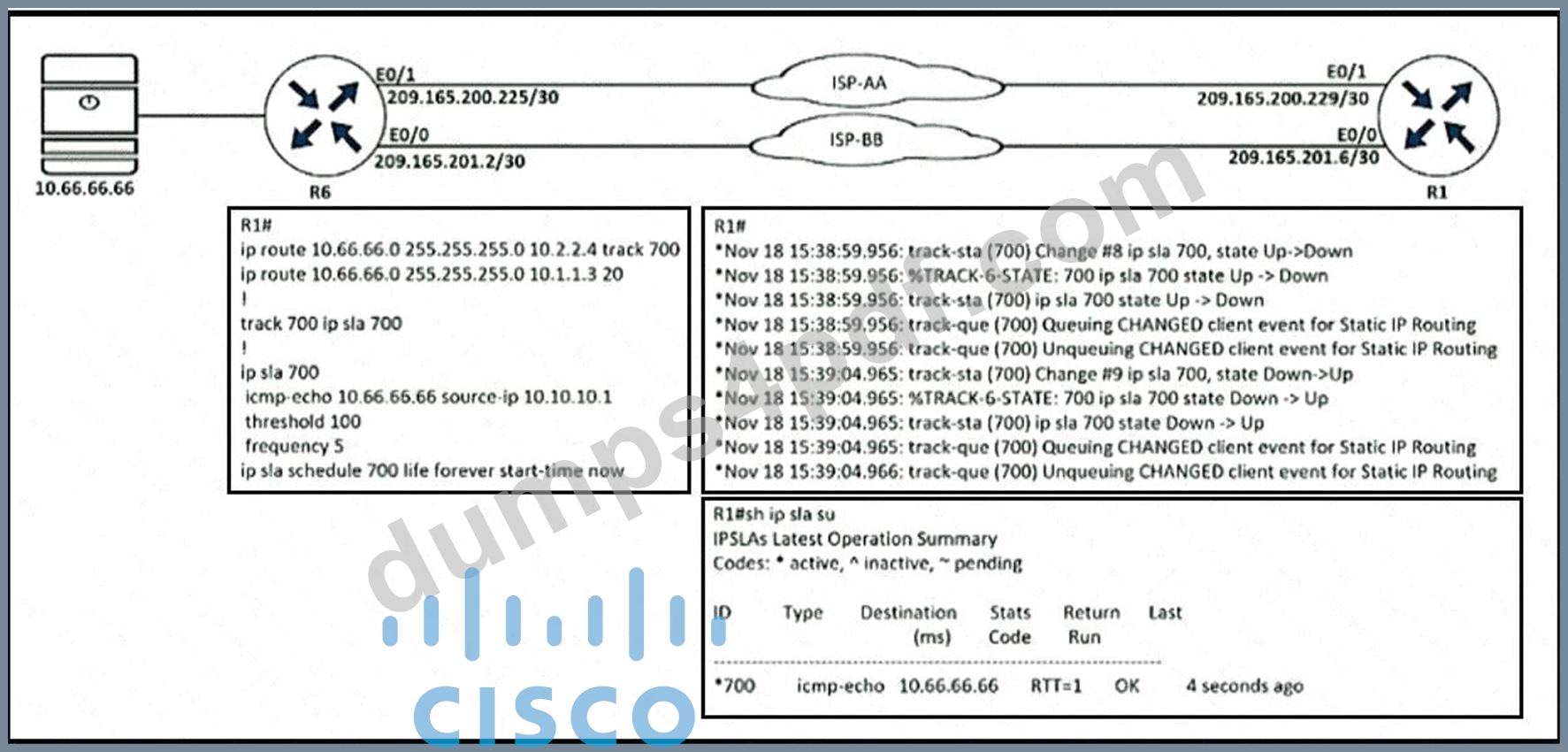
R1 is configured with IP SLA to check the availability of the server behind R6 but it kept failing. Which configuration resolves the issue?
- A. R1(config)# ip sla 700R1(config-track)# delay down 20 up 30
- B. R1(config)# ip sla 700R1(config-track)# delay down 30 up 20
- C. R1(config)# track 700 ip sla 700R1(config-track)# delay down 30 up 20
- D. R1(config)# track 700 ip sla 700R1(config-track)# delay down 20 up 30
Answer: C
NEW QUESTION # 56
Refer to the exhibit.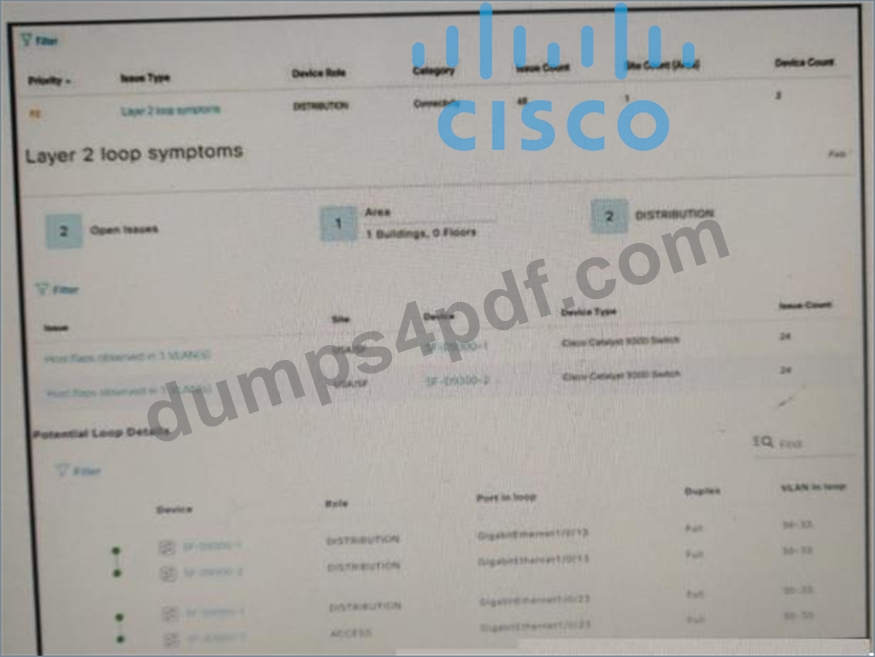
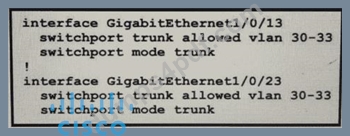
An engineer identifier a Layer 2 loop using DNAC. Which command fixes the problem in the SF-D9300-1 switch?
- A. spanning-tree portfast bpduguard
- B. spanning-tree loopguard default
- C. spanning-tree backbonesfast
- D. no spanning-tree uplinkfast
Answer: A
Explanation:
https://www.cisco.com/c/en/us/td/docs/cloud-systems-management/network-automation-and management
/dnacenter/tech_notes/b_dnac_sda_lan_automation_deployment.html
NEW QUESTION # 57
Refer to the exhibit.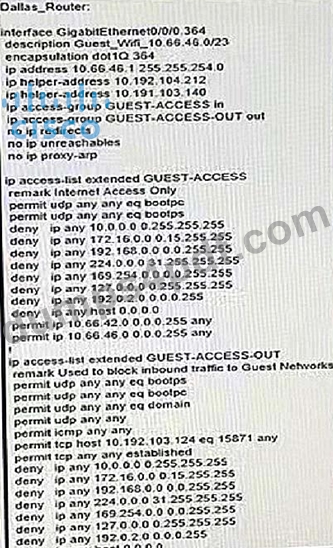
After a new regional office is set up,not all guests can access the internet via guest Wi Fi. Clients are getting the correct IP address from guest Wi-Fi VLAN 364. which action resolves the issue ?
- A. Allow DNS traffic through the outbound ACL
- B. Allow 10.66.46.0/23 in the inbound ACL
- C. Allow DNS traffic through the inbound ACL
- D. Allow 10.66.46.0/23 in the outbound ACL
Answer: C
NEW QUESTION # 58
Refer to the exhibit.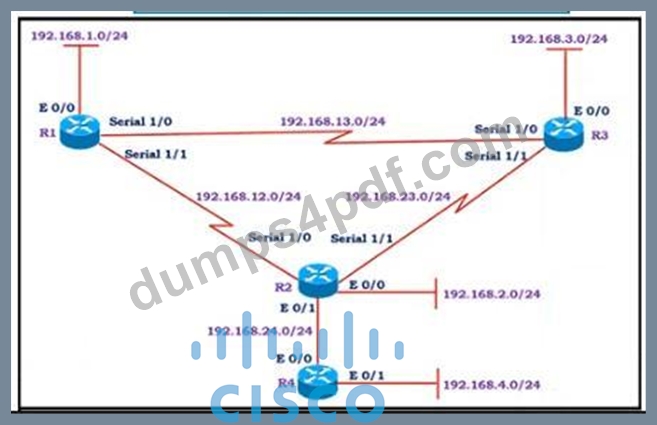
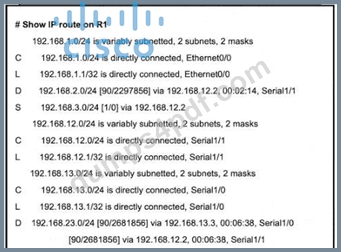
All the serial between R1, R2, and R3 have the Same bandwidth. User on the 192.168.1.0/24 network report slow response times while they access resource on network 192.168.3.0/24. When a traceroute is run on the path. It shows that the packet is getting forwarded via R2 to R3 although the link between R1 and R3 is still up. What must the network administrator to fix the slowness?
- A. Change the Administrative Distance of EIGRP to 5.
- B. Redistribute theR1 route to EIGRP
- C. Add a static route on R1 using the next hop of R3.
- D. Remove the static route on R1.
Answer: D
NEW QUESTION # 59
Refer to the exhibit.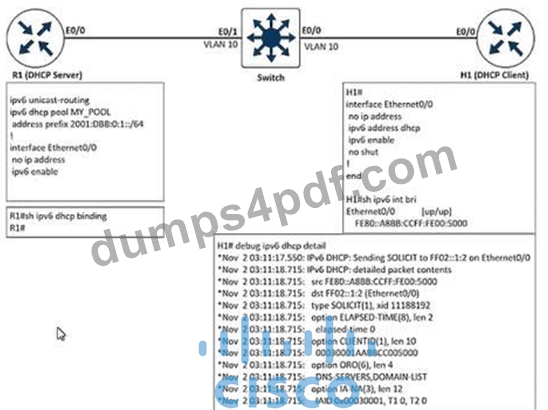
After the network administrator rebuilds the IPv6 DHCP server, clients are not getting the IPv6 address lease.
Which action resolves the issue?
- A. Add Ipv6 dhcp sarver MY_POOL under the interface ethernet 0/0 on H1.
- B. Remove FE80 A8BB CCFF FEOO 5000 assigned by the IPV6 DHCP server.
- C. Configure FF02::1:2 to discover al IPv6 OHCP cfcents
- D. Add Ipv6 dhcp server MY_POOL under the interface ethernet 0/0 on R1.
Answer: D
NEW QUESTION # 60
Refer to the exhibit. Which configuration resolves the IP SLA issue from R1 to the server?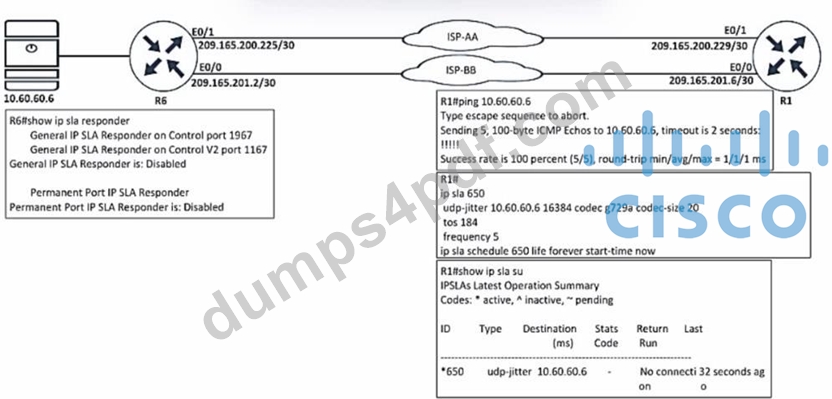
- A. R6(config)#ip sla responder
udp-echo ipaddress 10.60.60.6 po 5000 - B. R6(config)#ip sla responder
- C. R6(config)#ip sla schedule 10 life forever start-time now
- D. R6(config)#ip sla 650
R6(config-ip-sla)#udp-jitter 10.60.60.6
Answer: B
NEW QUESTION # 61
Refer to the exhibit. OSPF adjacency is broken between router A and router B. Which configuration on router B resolves the issue?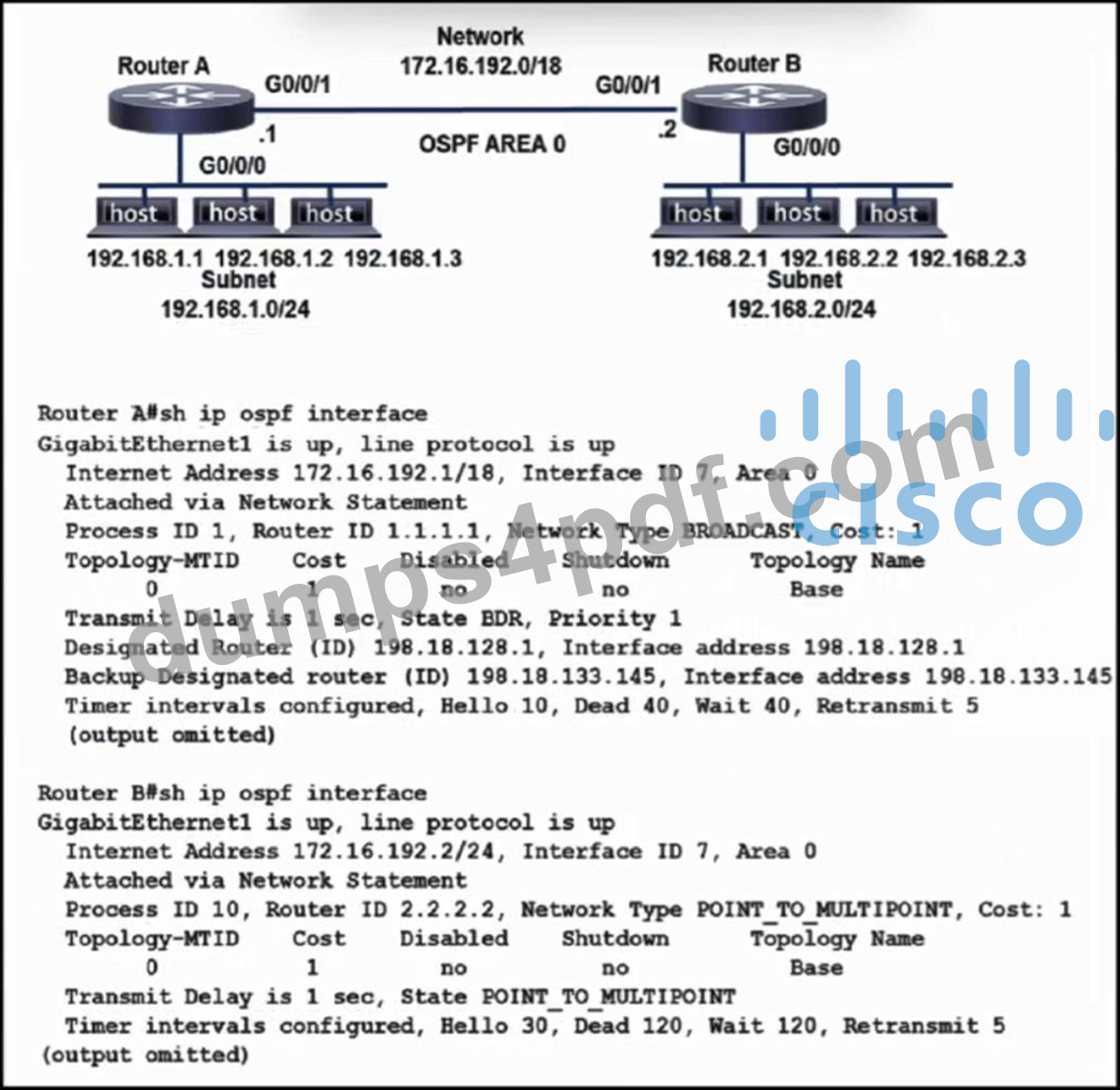
- A. Router B(config)#int gigabitEthernet 1
Router B(config-if)#ip ospf hello-interval 10
Router B(config-if)#ip ospf cost 1000 - B. Router B(config)#int gigabitEthernet 1
Router B(config-if)#ip address 172.16.192.2 255.255.255.192
Router B(config-if)#ip ospf network broadcast
Router B(config-if)#exit - C. Router B(config)#int gigabitEthernet 1
Router B(config-if)#ip address 172.16.192.2 255.255.192.0
Router B(config-if)# ip ospf network broadcast
Router B(config-if)#exit - D. Router B(config)#int gigabitEthernet 1
Router B(config)#ip ospf hello-interval 40
Router B(config-if)#router ospf 10
Router B(config-router)#router-id 1.1.1.1
Answer: B
Explanation:
The OSPF adjacency between Router A and Router B is broken because Router A is configured with an OSPF network type of "broadcast," while Router B is configured with "point-to-multipoint." OSPF adjacency requires the network types to match on both sides.
NEW QUESTION # 62
Refer to the exhibit.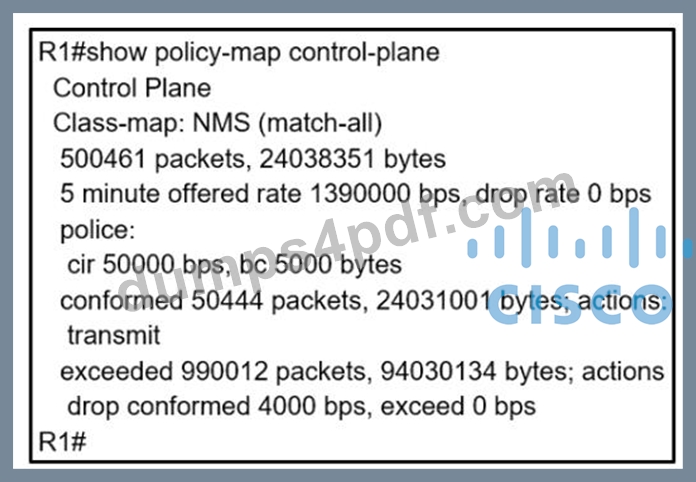
A company is evaluating multiple network management system tools. Trending graphs generated by SNMP data are returned by the NMS and appear to have multiple gaps. While troubleshooting the issue, an engineer noticed the relevant output. What solves the gaps in the graphs?
- A. Configure the CIR rate to a lower value that accommodates all the NMS tools
- B. Remove the class map NMS from being part of control plane policing.
- C. Separate the NMS class map in multiple class maps based on the specific protocols with appropriate CoPP actions
- D. Remove the exceed-rate command in the class map.
Answer: C
Explanation:
Reference:
https://tools.cisco.com/security/center/resources/copp_best_practices
The class-map NMS in the exhibit did not classify traffic into specific protocols so many packets were dropped. We should create some class-map to classify the receiving traffic. It is also a recommendation of CoPP/CPP policy:
"Developing a CPP policy starts with the classification of the control plane traffic. To that end, the control plane traffic needs to be first identified and separated into different class maps."
NEW QUESTION # 63
Refer to the exhibit.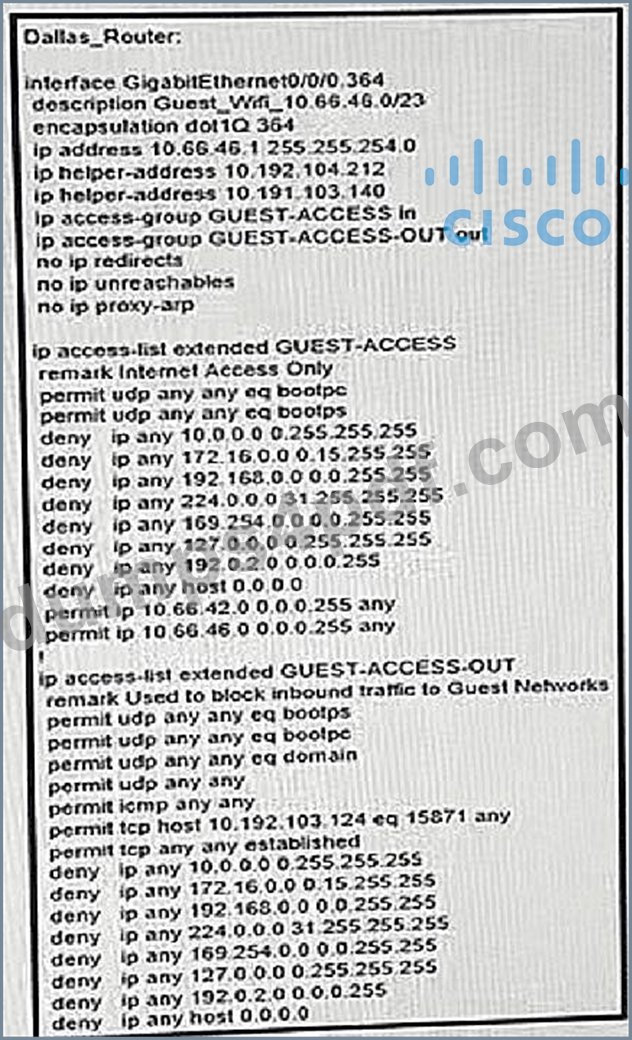
After a new regional office is set up,not all guests can access the internet via guest Wi Fi. Clients are getting the correct IP address from guest Wi-Fi VLAN 364. which action resolves the issue ?
- A. Allow DNS traffic through the outbound ACL
- B. Allow 10.66.46.0/23 in the inbound ACL
- C. Allow DNS traffic through the inbound ACL
- D. Allow 10.66.46.0/23 in the outbound ACL
Answer: C
NEW QUESTION # 64
Refer to the exhibit.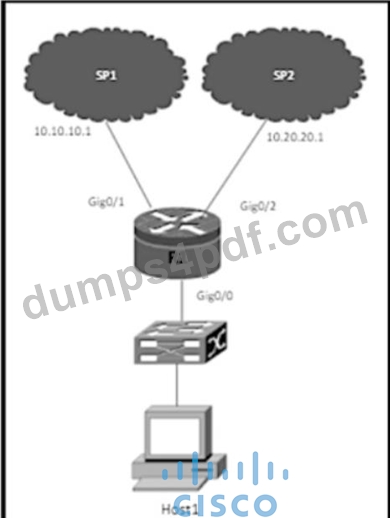
Refer to the exhibit. R1 uses SP1 as the primary path. A network engineer must force all SSH traffic generated from R1 toward SP2. Which configuration accomplishes the task?
A)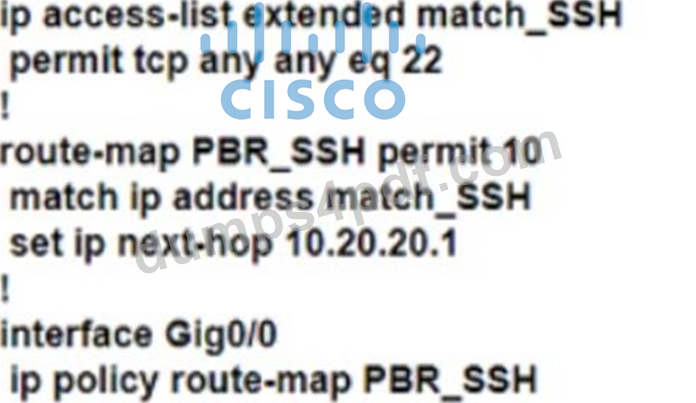
B)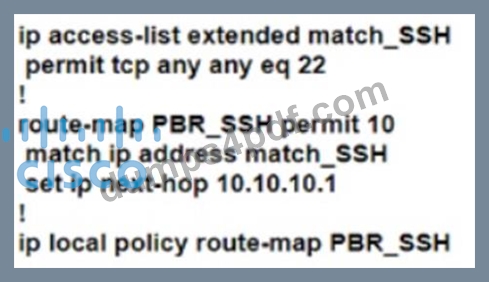
C)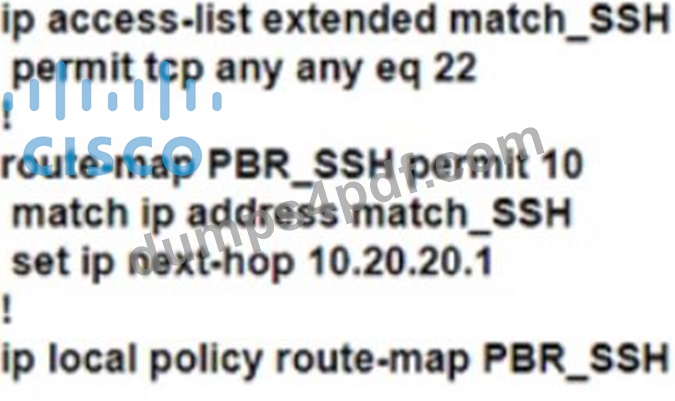
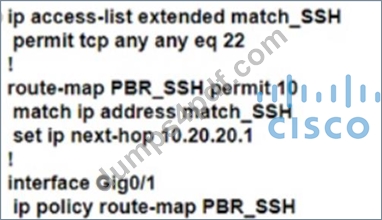
- A. Option
- B. Option
- C. Option
- D. Option
Answer: A
NEW QUESTION # 65
Refer to the exhibit. A network administrator is troubleshooting an authentication failure issue during login into R2 using a RADIUS server user account. The network administrator can ping the RADIUS server, but the user access to SSH is denied on R2. Which action resolves the issue?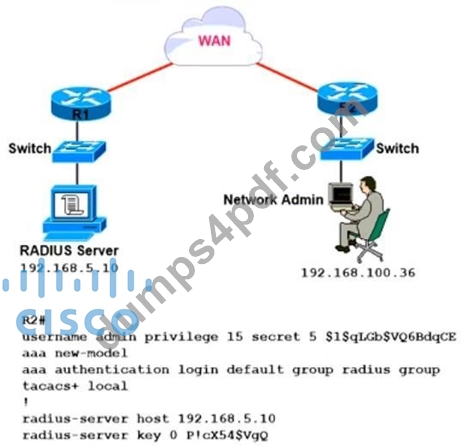
- A. Enable AAA authorization to allow SSH connections.
- B. Modify the aaa command to replace TACACS+ with RADIUS.
- C. Remove "local" from the aaa authentication command.
- D. Configure the username in RADIUS server database.
Answer: D
Explanation:
The configuration on R2 specifies that user authentication is done using RADIUS first, then TACACS+, and finally local as a fallback. The RADIUS server is reachable (ping succeeds), and the AAA authentication method is correct.
If the user credentials do not exist in the RADIUS server's user database, authentication will fail, and unless TACACS+ or local fallback is reachable and valid, access will be denied. Adding the appropriate user account (with correct credentials) on the RADIUS server resolves the SSH login issue.
NEW QUESTION # 66
Refer to the exhibit.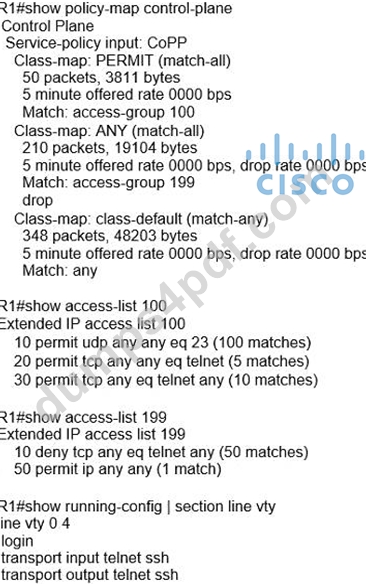
Which two actions restrict access to router R1 by SSH? (Choose two.)
- A. Remove sequence 10 from access list 100 and add sequence 20 deny tcp any any eq telnet to access list
199 - B. Remove class-map ANY from service-policy CoPP
- C. Configure transport input ssh on line vty and remove sequence 30 from access list 100.
- D. Configure transport output ssh on line vty and remove sequence 20 from access list 100.
- E. Configure transport output ssh on line vty and remove sequence 10 from access list 199.
Answer: C,D
NEW QUESTION # 67
In which two ways does the IPv6 First-Hop Security Binding Table operate? (Choose two.)
- A. by storing hashed keys for IPsec tunnels for the built-in IPsec features
- B. by the recovery mechanism to recover the binding table in the event of a device reboot
- C. by IPv6 HSRP to make sure neighbors are authenticated before being used as gateways
- D. by IPv6 routing protocols to securely build neighborships without the need of authentication
- E. by various IPv6 guard features to validate the data link layer address
Answer: B,E
Explanation:
Overview of the IPv6 First-Hop Security Binding Table
A database table of IPv6 neighbors connected to the device is created from information sources such as NDP snooping. This database, or binding table, is used by variousIPv6 guard features to validate the link-layer address (LLA), the IPv4 or IPv6 address, and the prefix binding of the neighbors to prevent spoofing and redirect attacks.
IPv6 First-Hop Security Binding Table Recovery MechanismThe IPv6 first-hop security binding table recovery mechanism enables the binding table to recover in the event of a device reboot.
Reference: https://www.cisco.com/c/en/us/td/docs/ios-xml/ios/ipv6_fhsec/configuration/15-s/ip6-fhs-bind- table.html
NEW QUESTION # 68
Refer to the exhibit.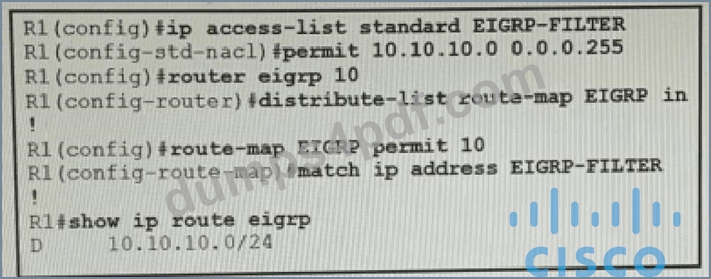
An engineer must filter incoming EIGRP updates to allow only a set of specific prefixes. The distribute list is tested, and it filters out all routes except network 10.10.10.0/24. How should the engineer temporarily allow all prefixes to be learned by the routers again without adjusting the existing access list?
- A. A permit any statement should be added before completing the ACL with the required prefixes and then the permit any statement can be removed.
- B. A continue statement should be added within the permit 10 statement before completing the ACL with the required prefixes, and then the continue statement can be removed.
- C. A permit 20 statement should be added before completing the ACL with the required prefixes, and then the permit 20 statement can be removed.
- D. An extended access list must be used instead of a standard access list to accomplish the task
Answer: B
NEW QUESTION # 69
Refer to the exhibit. An engineer is monitoring reachability of the configured default routes to ISP1 and ISP2. The default route from ISP1 is preferred if available. How is this issue resolved?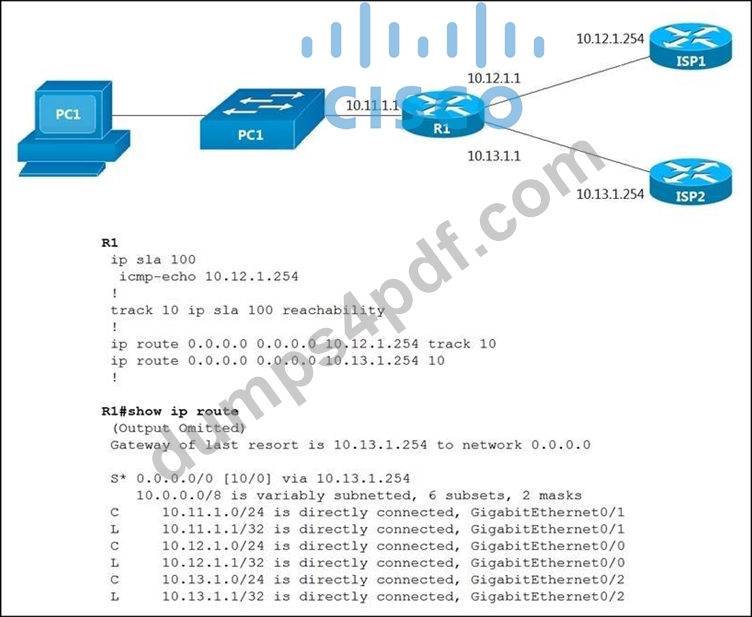
- A. Start IP SLA by defining frequency and scheduling it
- B. Start IP SLA by matching numbers for track and ip sla commands
- C. Use the same AD for both default routes
- D. Use the icmp-echo command to track both default routes
Answer: A
Explanation:
https://www.cisco.com/c/en/us/support/docs/ip/ip-routing/200785-ISP-Failover-with-default- routes-using-I.html In the above configuration we have not had activated our IP SLA operation. We can start it with this command:
R1(config)#ip sla schedule 100 life forever start-time now
Also we should specific the rate of ICMP echo:
R1(config-ip-sla-echo)#frequency 5 // Send ICMP echo every 5 seconds
NEW QUESTION # 70
Refer to the exhibit. An engineer must establish a point-to-point GRE VPN between R1 and the remote site. Which configuration accomplishes the task for the remote site?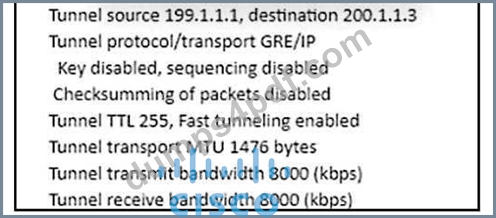
- A. Interface Tunnel1
tunnel source 199.1.1.1
tunnel destination 200.1.1.3
ip address 192.168.1.3 255.255.255.0 - B. Interface Tunnel1
tunnel source 200.1.1.3
tunnel destination 199.1.1.1
ip address 192.168.1.1.255.255.255.0 - C. Interface Tunnel
lunnel source 199.1.1.1
tunnel destination 200.1.1.3
ip address 192.168.1.1.255.255.255.0 - D. Interface Tunnel1
tunnel source 200.1.1.3
tunnel destination 199.1.1.1
ip address 192.168.1.3.255.255.255.0
Answer: D
NEW QUESTION # 71
Exhibit: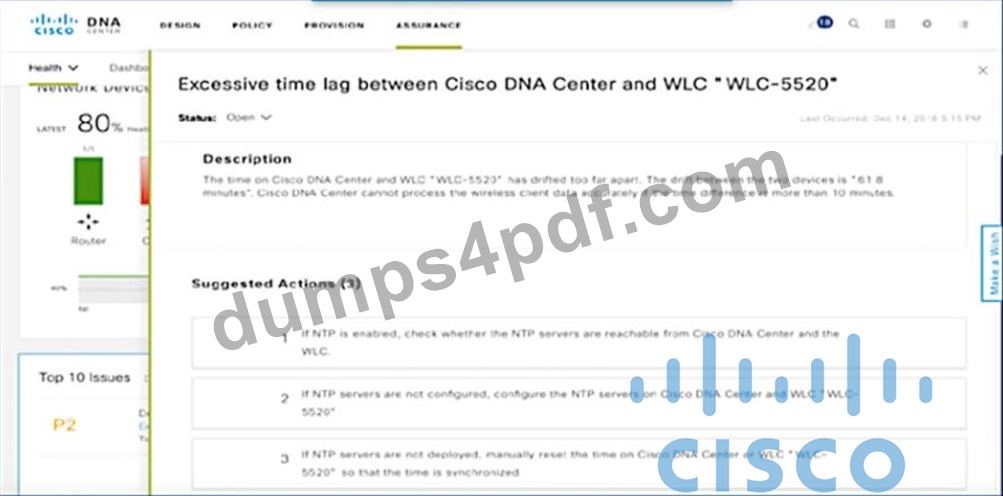
NTP is configured across the network infrastructure and Cisco DNA Center. An NTP issue was reported on the Cisco DNA Center at 17:15. Which action resolves the issue?
- A. Reset the NTP server to resolve any synchronization issues for all devices
- B. Check and resolve reachability between Cisco DNA Center and the NTP server
- C. Check and configure NTP on the WLC and synchronize with Cisco DNA Center
- D. Check and resolve reachability between the WLC and the NTP server
Answer: C
Explanation:
Excessive time lag between Cisco DNA Center and device: The time difference between Cisco DNA Center and the device IP Address has drifted too far apart. CiscoDNA Center cannot process the device data accurately if the time difference is more than 3 minutes.
NEW QUESTION # 72
Refer to the exhibit.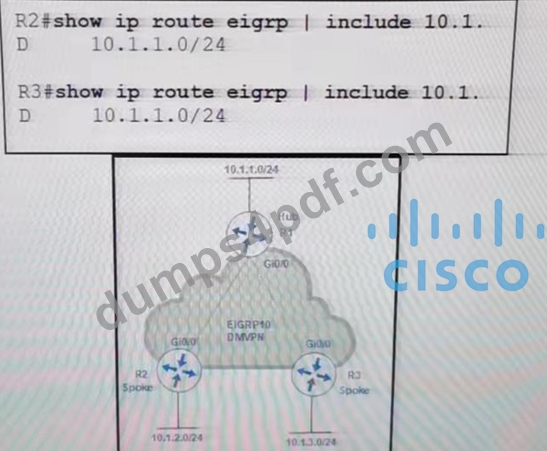
An engineer configures DMVPN and receives the hub location prefix of 10.1.1.0724 on R2 and R3 The R3 prefix of 10 1.3.0/24 is not received on R2. and the R2 prefix 10.1,2.0/24 is not received on R3. Which action reserves the issue?
- A. There is no spoke-to-spoke connection DMVPN configuration should be modified with a manual neighbor relationship configured between R2 and R3 and confirmed bb use of the show ip eigrp neighbor command.
- B. Split horizon prevents the routes from being advertised between spoke routers it should be disabled with the no ip split-horizon eigrp 10 command on the Gi0/0 interface of R1.
- C. There is no spoke-to-spoke connection DMVPN configuration should be modified to enable a tunnel connection between R2 and R3 and neighbor relationship confirmed by use of the show ip eigrp neighbor command
- D. Split horizon prevents the routes from being advertised between spoke routers it should be disabled with the command no ip split-horizon eigrp 10 on the tunnel interface of R1
Answer: D
Explanation:
In this topology, the Hub router will receive advertisements from R2 Spoke router on its tunnel interface. The problem here is that it also has a connection with R3 Spoke on that same tunnel interface. If we don't disable split-horizon, then the Hub will not relay routes from R2 to R3 and the other way around. That is because it received those routes on the same interface tunnel and therefore it cannot advertise back out that same interface (split-horizon rule). Therefore we must disable splithorizon on the Hub router to make sure the Spokes know about each other.
NEW QUESTION # 73
Refer to the exhibit.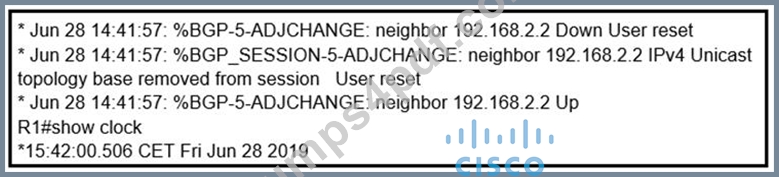
An engineer is troubleshooting BGP on a device but discovers that the clock on the device does not correspond to the time stamp of the log entries. Which action ensures consistency between the two times?
- A. Make sure that the clock on the device is synchronized with an NTP server.
- B. Configure the service timestamps log uptime command in global configuration mode.
- C. Configure the logging clock synchronize command in global configuration mode.
- D. Configure the service timestamps log datetime localtime command in global configuration mode.
Answer: D
Explanation:
https://www.cisco.com/c/en/us/td/docs/routers/xr12000/software/xr12k_r3-9/system_management/command
/reference/yr39xr12k_chapter4.html#wp1784026936
By default, syslog and debug messages are stamped by UTC, regardless of the time zone that device configured. You should append localtime key word to "service timestamp {log | debug} datetime msec" global command to change that behavior.
https://community.cisco.com/t5/networking-documents/router-log-timestamp-entries-are-different-from-the- system-clock/ta-p/3132258
https://www.cisco.com/E-Learning/bulk/public/tac/cim/cib/using_cisco_ios_software/cmdrefs
/service_timestamps.htm
NEW QUESTION # 74
Refer to the exhibit.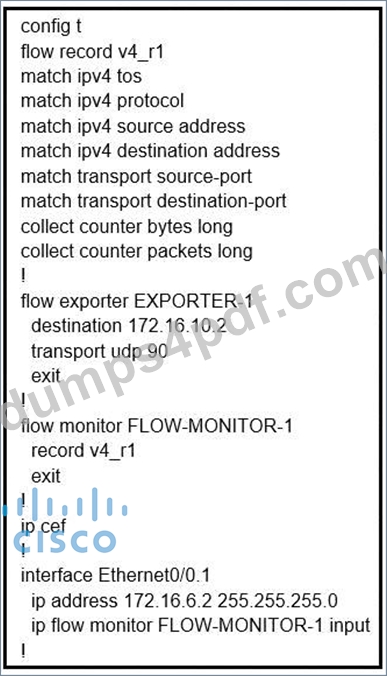
Why is the remote NetFlow server failing to receive the NetFlow data?
- A. The flow exporter is configured but is not used.
- B. The flow monitor is applied in the wrong direction.
- C. The destination of the flow exporter is not reachable.
- D. The flow monitor is applied to the wrong interface.
Answer: A
NEW QUESTION # 75 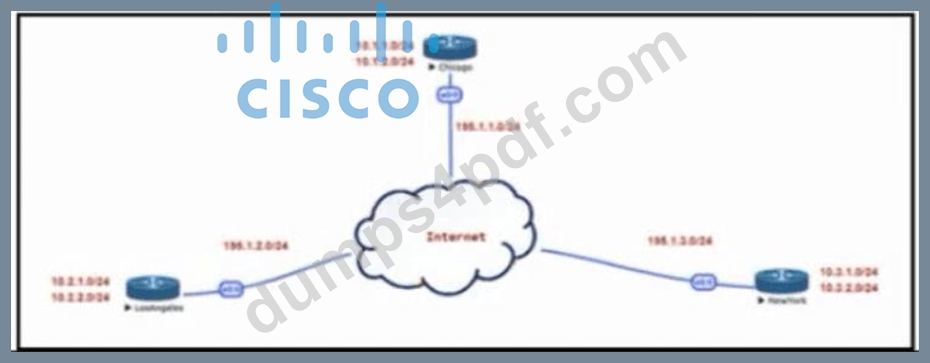
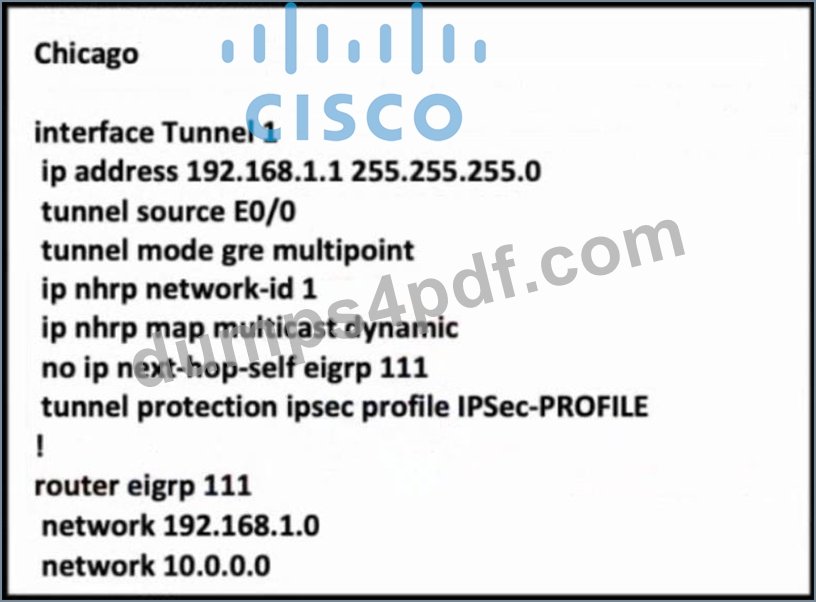
Refer to the exhibit. The Los Angeles and New York routers are receiving routes from Chicago but not from each other. Which configuration fixes the issue?
- A. Interface Tunnel1tunnel mode Ipsec Ipv4
- B. Interface Tunnel1no ip split-horizon eigrp 111
- C. Interface Tunnel1tunnel protection ipsec profile IPSec-PROFILE
- D. Interface Tunnel1Ip next-hop-self elgrp 111
Answer: B
Explanation:
In this topology, Chicago router (Hub) will receive advertisements from Los Angeles (Spoke1) router on its tunnel interface. The problem here is that it also has a connection with New York (Spoke2) on that same tunnel interface. If we don't disable EIGRP split-horizon, then the Hub will not relay routes from Spoke1 to Spoke2 and the other way around. That is because it received those routes on interface Tunnel1 and therefore it cannot advertise back out that same interface (splithorizon rule). Therefore we must disable split-horizon on the Hub router to make sure the Spokes know about each other.
NEW QUESTION # 76
......
Cisco 300-410 exam covers a wide range of topics related to advanced routing and services in enterprise networks. These topics include advanced routing protocols such as OSPFv3 and BGP, VPN technologies such as DMVPN and FlexVPN, and network infrastructure services such as QoS, NAT, and DHCP. 300-410 exam also covers network automation and programmability using tools such as Python and Cisco DNA Center.
The Most In-Demand 300-410 Pass Guaranteed Quiz : https://pass4sure.dumps4pdf.com/300-410-valid-braindumps.html